Getting Started with Decentralized Trading
Decentralized trading is changing how people invest by letting you keep control of your crypto instead of relying on exchanges. Learn how DeFi platforms let you trade directly from your own wallet.
Written by Kacper Tomasiak

The world of cryptocurrency has opened doors to entirely new ways of trading and investing. While most people start by simply buying Bitcoin or Ethereum and holding them, many eventually discover the exciting world of decentralized trading. This might sound complicated, but it's actually just a different way to trade cryptocurrencies that gives you more control over your money.
Decentralized trading represents a major shift from traditional finance. Instead of relying on banks or big financial institutions to hold and manage your funds, you keep complete control while still being able to trade, lend, and even use advanced strategies like leverage. Let's break down everything you need to know to get started safely.
What Is Decentralized Trading?
Decentralized trading happens on platforms that don't have a central authority controlling your funds. Think of it like the difference between keeping your money in a bank vault (where the bank controls access) versus keeping it in your own personal safe at home (where only you have the key).
When you trade on decentralized platforms, your cryptocurrencies stay in your own wallet the entire time. You connect your wallet to the trading platform, execute trades, but your funds never leave your control. This is fundamentally different from traditional crypto exchanges, where you have to deposit your crypto first and trust them to hold it safely.
Traditional Trading vs DeFi Trading
Traditional centralized exchanges work much like banks. You create an account, go through identity verification, deposit your money, and then you can trade. The exchange holds your funds and processes all transactions on their internal systems. While this can be convenient, it also means you're trusting that company with your money.
Decentralized Finance (DeFi) trading flips this model completely. You maintain custody of your cryptocurrencies in your own wallet, and when you want to trade, you interact directly with smart contracts (automated programs) on the blockchain. These smart contracts execute trades automatically without needing human intervention or a company to facilitate the transaction.
Why People Choose Decentralized Platforms
The main appeal of decentralized trading is control. You never have to worry about an exchange freezing your account, going bankrupt, or getting hacked and losing your funds. Your crypto stays with you at all times.
Decentralized platforms also often offer more innovative financial products. You can access advanced trading strategies, earn yield on your holdings, or participate in new protocols that simply don't exist in traditional finance. Plus, many DeFi platforms don't require you to provide personal information or complete lengthy verification processes.

Decentralized exchanges utilize smart contracts, liquidity pools and governance. DEXs give a sense of privacy, but their fees are less predictable.
Understanding DeFi Trading Basics
DeFi trading encompasses several different types of transactions, each serving different purposes. The most basic form is spot trading, but the ecosystem has evolved to include much more sophisticated options.
Before diving into any type of DeFi trading, you'll need to get your crypto into the right ecosystem. Most DeFi applications run on networks like Ethereum, Polygon, or newer chains like Arbitrum. The easiest way to get started is by buying crypto through a user-friendly platform like Swapped.com, where you can purchase various cryptocurrencies with low fees and send them directly to your wallet.
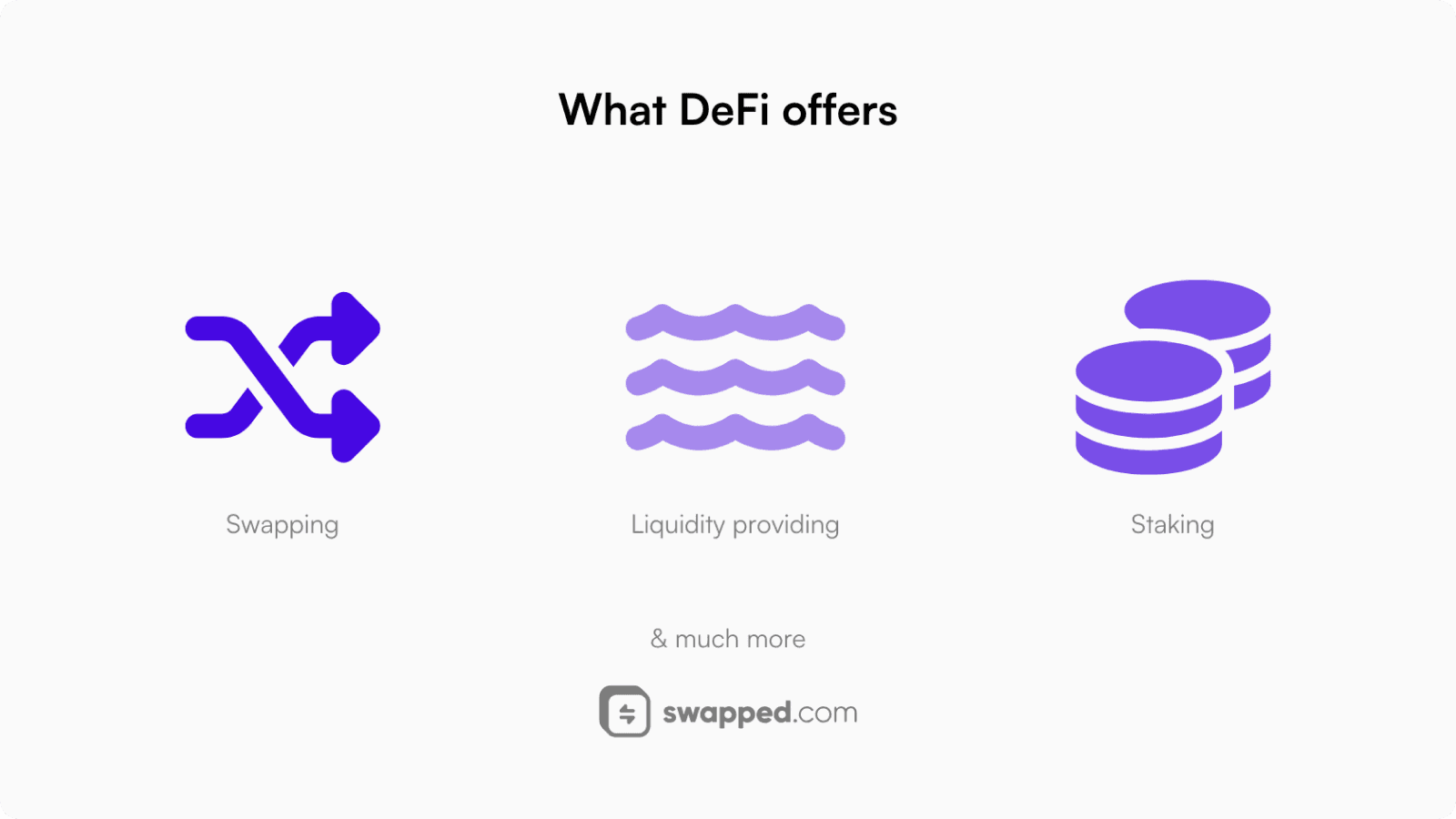
There's many opportunities in DeFi, but you need to beware of the possible risks.
Spot Trading Made Simple
Spot trading is the most straightforward type of crypto trading. You're simply exchanging one cryptocurrency for another at the current market price. For example, you might trade some of your Ethereum for a newer token you're interested in.
On decentralized platforms, this happens through something called automated market makers (AMMs). Instead of matching buyers and sellers like traditional exchanges do, AMMs use pools of cryptocurrencies and mathematical formulas to determine prices. When you want to trade, you're essentially swapping your crypto with these pools.
The beauty of DeFi spot trading is that it's usually available 24/7, has relatively low barriers to entry, and you can often find tokens that aren't available on centralized exchanges. However, you'll need to pay network fees (called gas fees) for each transaction, which can add up during busy periods.
The World of Derivatives Trading
Once you understand spot trading, you might want to explore derivatives. These are financial instruments that derive their value from underlying assets (like Bitcoin or Ethereum) but allow for more complex trading strategies.
Derivatives in DeFi work similarly to traditional finance but with some key differences. You can take positions on whether you think a cryptocurrency's price will go up or down, use leverage to amplify your potential gains (and losses), or hedge existing positions to reduce risk.
The main advantage of DeFi derivatives is that they're typically more accessible than traditional derivatives markets. You don't need to be an accredited investor or meet minimum balance requirements. However, they're also riskier and require a solid understanding of how they work before you start trading.
Advanced Trading Concepts
As you become more comfortable with basic DeFi trading, you might want to explore more advanced strategies. These can potentially increase your profits, but they also come with significantly higher risks.
The key to success with advanced trading is education and starting small. Never risk more money than you can afford to lose, and always make sure you understand exactly how a trading strategy works before committing significant funds.
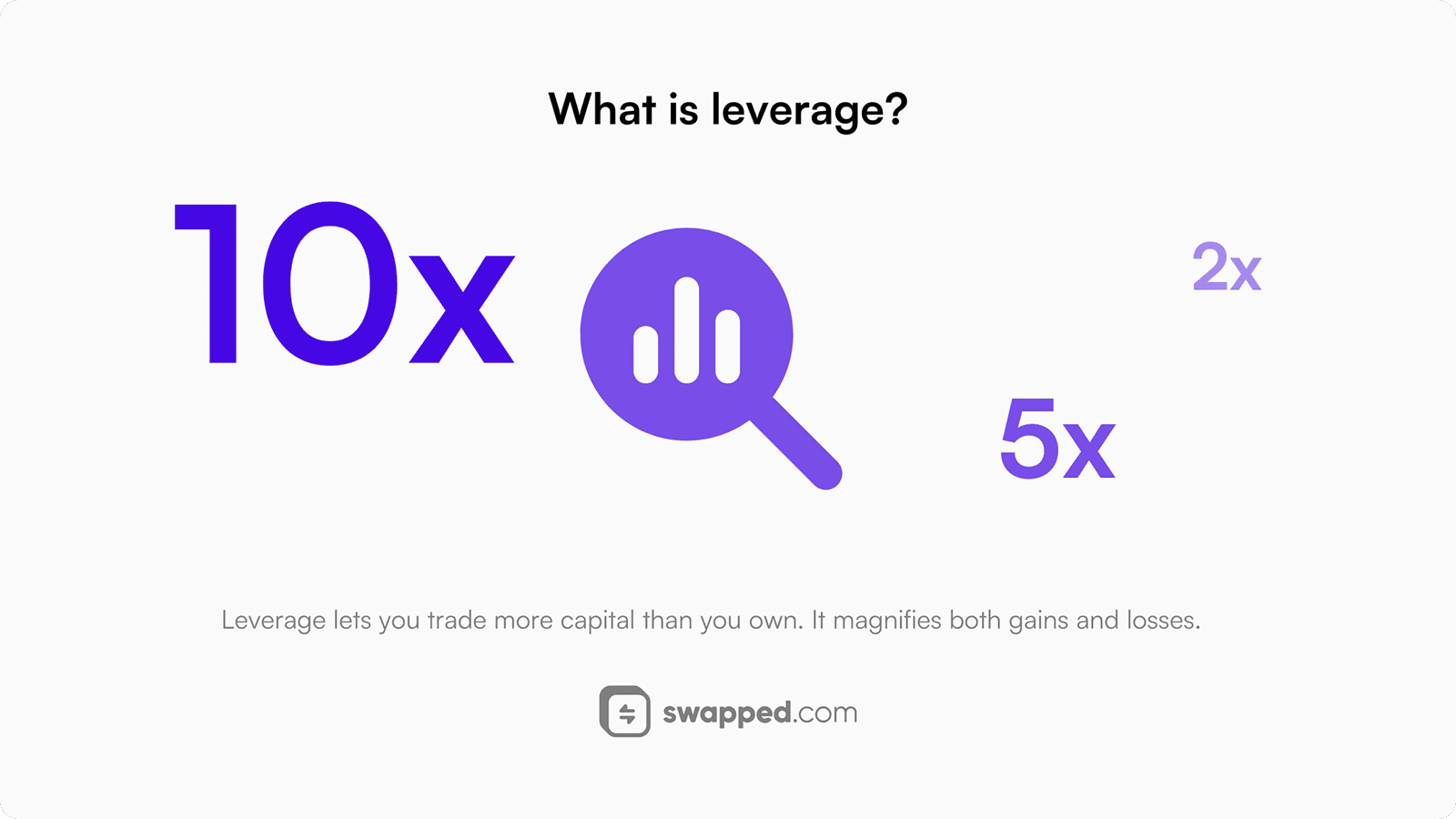
Using leverage multiplies exposure to price movements. Even small market shifts can lead to significant gains or losses.
Leverage Trading and How It Works
Leverage allows you to control a larger position than you could with just your own money. For example, with 2x leverage, you could control $1,000 worth of Bitcoin with only $500 of your own money. The platform essentially lends you the additional $500.
Here's a simple example: Let's say Bitcoin is trading at $50,000 and you think it's going to go up. With $500 of your own money and 2x leverage, you could buy $1,000 worth of Bitcoin. If Bitcoin rises to $55,000 (a 10% increase), your $1,000 position would be worth $1,100. After paying back the $500 loan, you'd have $600 - a $100 profit on your $500 investment, or 20%.
However, leverage works both ways. If Bitcoin dropped to $45,000, your $1,000 position would be worth $900. After paying back the $500 loan, you'd only have $400 left from your original $500 investment.
Perpetual Contracts Made Simple
Perpetual contracts (or "perps") are a popular type of derivative that allows you to speculate on cryptocurrency prices without actually owning the underlying asset. Think of them as a bet on whether a price will go up or down.
Unlike traditional futures contracts, perpetual contracts don't have an expiration date. You can hold your position for as long as you want, as long as you maintain sufficient margin (collateral) to cover potential losses.
Perps are popular because they often track the underlying asset's price very closely, they're highly liquid (meaning you can easily enter and exit positions), and they allow for both long (betting prices go up) and short (betting prices go down) positions.
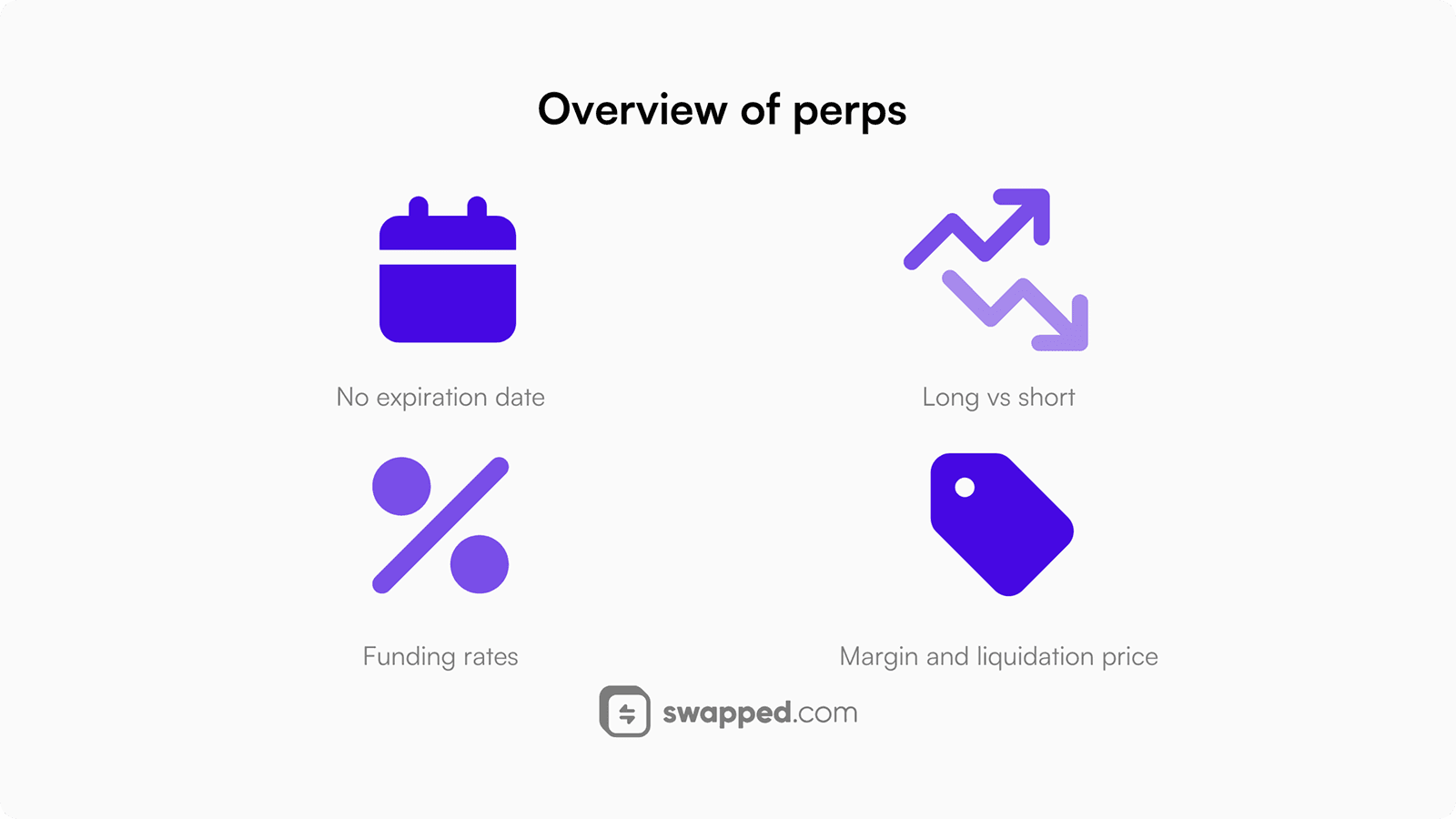
Perps make it possible to trade both rising and falling markets using borrowed funds.
Futures Trading Basics
Futures contracts are agreements to buy or sell an asset at a specific price on a specific date in the future. In crypto, futures allow you to lock in prices for cryptocurrencies you want to buy or sell later.
For example, if it's currently January and you think Ethereum will be worth more in March, you could buy an Ethereum futures contract for March delivery at today's price. If Ethereum's price rises by March, you'll profit from the difference. If it falls, you'll lose money.
Futures can be useful for hedging (protecting against price movements) or speculation (trying to profit from price predictions). However, they require careful attention to expiration dates and margin requirements.
Popular DeFi Trading Platforms
The DeFi ecosystem has produced numerous innovative trading platforms, each offering different features and advantages. Some focus on simple spot trading, while others specialize in advanced derivatives.
When choosing a platform, consider factors like the types of trading available, fees, security track record, and user interface. It's also important to understand that different platforms may be built on different blockchains, which affects everything from transaction speed to costs.
Exploring Hyperliquid
Hyperliquid has emerged as one of the most sophisticated decentralized derivatives exchanges. It offers perpetual contracts with leverage up to 50x, making it particularly attractive to experienced traders looking for advanced features.
What sets Hyperliquid apart is its focus on providing a trading experience similar to traditional centralized exchanges while maintaining the benefits of decentralization. The platform offers features like advanced order types, detailed charts, and high-speed trading execution.
For beginners, Hyperliquid might seem overwhelming at first, but it represents the cutting edge of what's possible in DeFi trading. The platform emphasizes transparency by showing all trades and liquidations on-chain, allowing users to see exactly how the market is behaving in real-time.
If you're interested in trying platforms like Hyperliquid, you can buy Hyperliquid with Swapped.com and have the tokens sent directly to your wallet. We offer competitive rates and a straightforward process that gets you trading faster.
Your First Trade
When you're ready to make your first DeFi trade, start small and simple. Choose a well-established platform, understand all the fees involved (both the platform's fees and network fees), and don't rush into complex strategies like leverage trading.
Consider starting with basic spot trading to get familiar with how decentralized platforms work. Try swapping a small amount of one cryptocurrency for another, paying close attention to how the process works and what costs are involved.
Remember that every transaction on the blockchain costs gas fees, which can vary significantly depending on network congestion. These fees are separate from any trading fees the platform charges, so factor them into your trading decisions.
DeFi trading represents an exciting evolution in how we think about financial markets and personal control over our money. While it offers unprecedented opportunities, it also requires more personal responsibility than traditional trading. Start slowly, keep learning, and never risk more than you can afford to lose. With proper preparation and a cautious approach, decentralized trading can open up a whole new world of financial possibilities.
Resources
If you're interested in diving deeper and expanding your knowledge of decentralized trading, here are some suggestions: