How to Deposit Crypto from Wallets and Exchanges
Moving crypto can seem confusing, but once you know how wallet addresses and networks work, it’s easy. Tools like Swapped Connect handle the hard parts for you, so deposits are smooth and safe.
Written by Kacper Tomasiak
Moving your crypto around can feel scary at first. You've probably heard horror stories about people sending Bitcoin to the wrong address and losing thousands of dollars forever. The good news? Depositing crypto from wallets or exchanges is actually pretty simple once you understand the basics.
Whether you're trying to move Bitcoin from your personal wallet to an exchange, or deposit Ethereum into a DeFi platform, crypto deposits involve more complexity than most beginners expect. The good news is that understanding the basics and using the right tools can make the whole process much smoother.
Understanding Crypto Deposits
A crypto deposit is simply moving your cryptocurrency from one wallet or exchange to another. Think of it like transferring money between bank accounts, except instead of account numbers, you're dealing with wallet addresses that look like random strings of letters and numbers.
When you deposit crypto, you're essentially sending it across a blockchain network to reach its destination. This might be moving your Bitcoin from a hardware wallet to an exchange, or sending USDC from your wallet to a lending platform.
The tricky part is that not all cryptocurrencies work on the same networks. Bitcoin runs on its own network, Ethereum has its own, and there are dozens of other networks like Solana, Ripple, and Arbitrum. Each network has different rules, fees, and supported tokens.
Why Deposits Can Be Complicated
Most crypto newcomers assume that depositing crypto should work like sending an email. You enter an address, hit send, and it arrives instantly. Unfortunately, the reality involves several potential roadblocks.
First, you need to make sure you're using the correct network. Sending Ethereum on the wrong network could mean your crypto gets lost forever. Second, different platforms support different tokens, so the crypto you want to deposit might not even be accepted. Third, network fees can be unpredictable and expensive, especially on Ethereum during busy periods.
Common Deposit Challenges That Trip Up Beginners
Most crypto deposit problems stem from the same few issues. Understanding these beforehand can save you time, money, and stress.
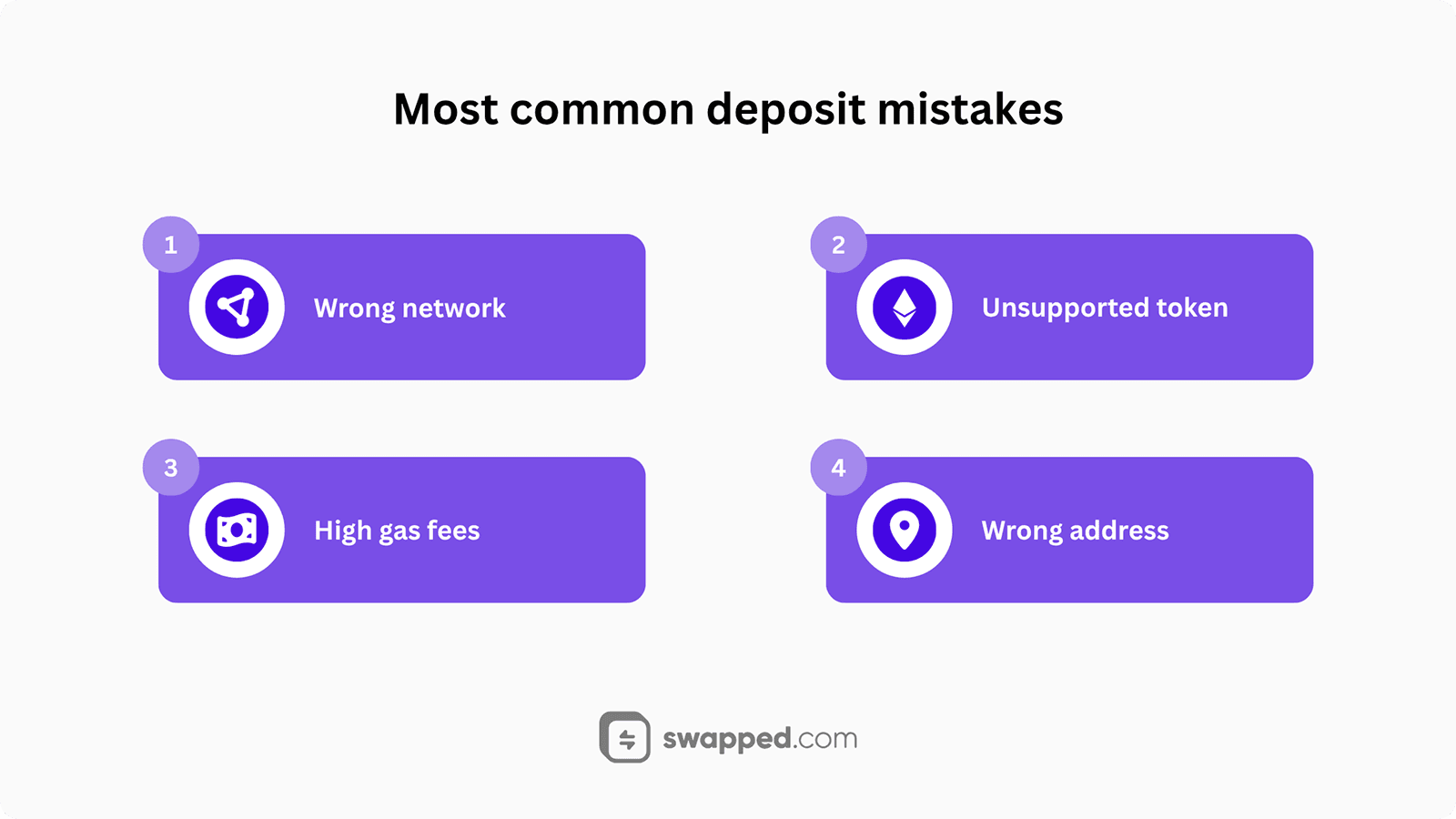
Most crypto deposit errors come down to a few simple but costly mistakes.
Network Compatibility Issues
The biggest headache for crypto users is network compatibility. Let's say you have USDT (Tether) in your wallet and want to deposit it to an exchange. Sounds simple, right? But USDT exists on multiple networks – Ethereum, Tron, Polygon, and others. The exchange might only accept USDT on Ethereum, but your USDT is on Polygon.
This mismatch means you either can't deposit at all, or you need to bridge your tokens to the correct network first, which involves additional steps, fees, and waiting time.
Unsupported Token Problems
Another common issue is trying to deposit a token that the receiving platform doesn't support. Maybe you have a newer altcoin in your wallet, but the exchange or DeFi platform only accepts major cryptocurrencies like Bitcoin and Ethereum.
Traditionally, this would require you to first swap your tokens for something the platform accepts, then make the deposit. That's two separate transactions, double the fees, and more complexity.
Gas Fees and Transaction Costs
Network fees, called "gas fees" on Ethereum, can sometimes cost more than the crypto you're trying to deposit. These fees fluctuate based on network congestion, so what costs $5 in the morning might cost $50 during peak hours.
For smaller deposits, high gas fees can make the transaction economically pointless. You might want to deposit $100 worth of crypto, but if the network fee is $30, you're losing nearly a third of your deposit just to move it.
Step-by-Step Guide to Making Crypto Deposits
Understanding the traditional deposit process helps you appreciate why newer solutions like Swapped Connect are so valuable.
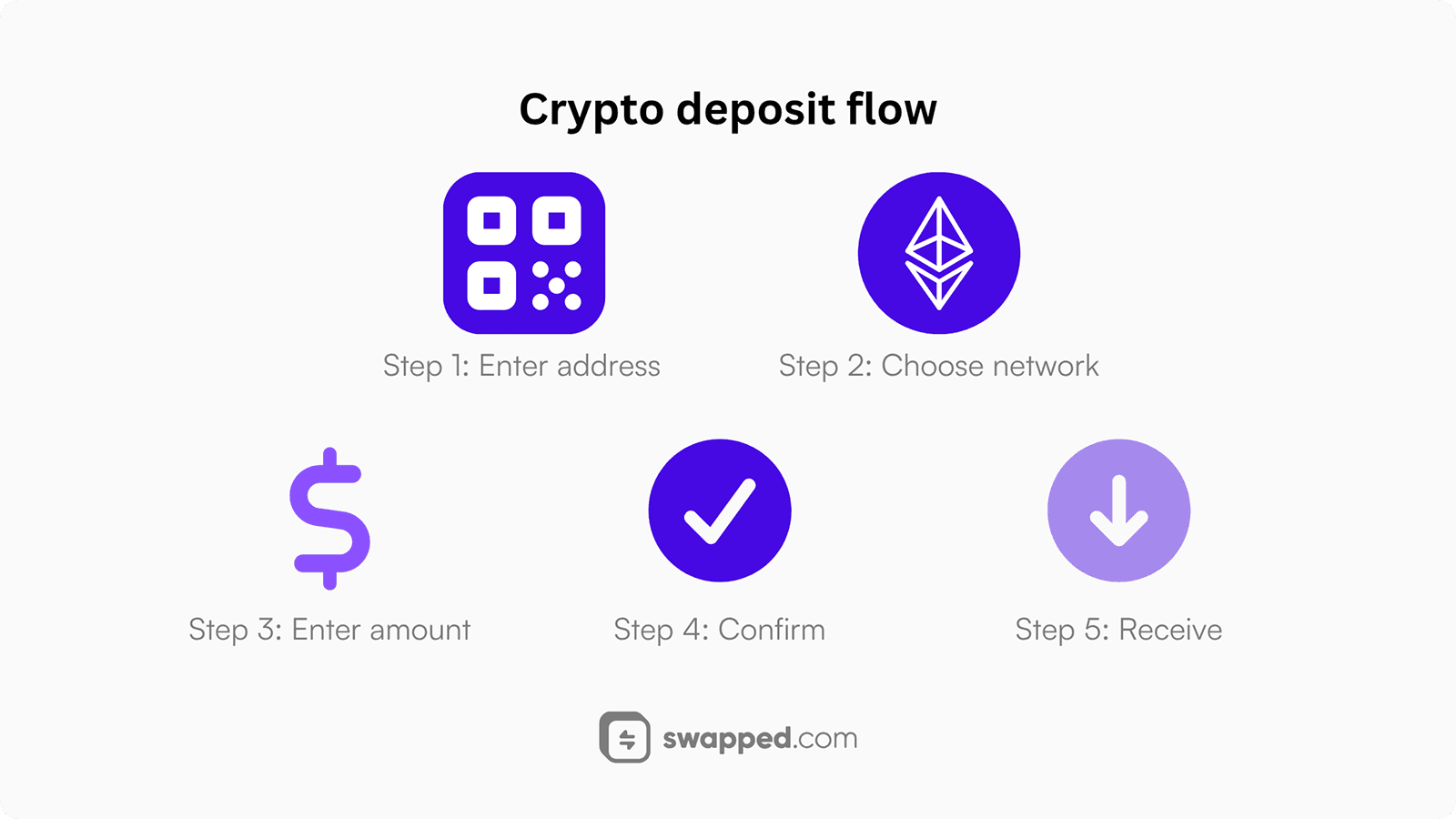
Sending crypto involves more steps than most people expect, and each one carries risk if done incorrectly.
Preparing Your Deposit
Start by checking what the receiving platform accepts. Look at their deposit page to see which cryptocurrencies and networks they support. This information is usually found in the "Deposit" or "Wallet" section of exchanges and platforms.
Next, make sure you have enough of the network's native token to pay gas fees. For Ethereum deposits, you need ETH for gas. For Polygon deposits, you need POL. Without these, your transaction won't go through.
Getting the Correct Deposit Address
The receiving platform will provide you with a deposit address – a long string of characters that looks something like "0x742d35cc6634c0532925a3b8d." This address is specific to the cryptocurrency and network you're depositing.
Copy this address carefully. Even one wrong character means your crypto goes to the wrong place and could be lost forever. Many users double-check by pasting the address and comparing it character by character.
Initiating the Deposit
In your wallet or exchange, find the send or withdraw function. Paste the deposit address, enter the amount you want to send, and select the correct network. This is crucial – the network you choose must match what the receiving platform expects.
Review everything twice before confirming. Check the address, amount, network, and estimated fees. Once you confirm, the transaction usually can't be reversed.
How Swapped Connect Eliminates Deposit Issues
The traditional deposit process involves multiple steps, potential errors, and various fees that can add up quickly. We built Swapped Connect specifically to solve these problems and make crypto deposits as simple as they should be.
Automatic Token Swapping and Bridging
Swapped Connect's biggest advantage is that it handles token compatibility automatically. When you want to deposit crypto that isn't directly supported, our widget automatically swaps or bridges your tokens to the correct format.
Let's say you want to deposit to a platform that only accepts USDC on Ethereum, but you have DAI on Polygon. Instead of manually bridging your DAI to Ethereum, then swapping it to USDC, Swapped Connect does both steps automatically in the background. You just select what you want to deposit, and we handle the rest.
Pre-Filled Wallet Information
One of the most tedious parts of crypto deposits is entering wallet addresses and other details repeatedly. Swapped Connect pre-fills all this information based on your previous transactions and preferences.
This eliminates the risk of typing errors and speeds up the entire process. You don't need to copy and paste long wallet addresses or worry about selecting the wrong network.
Gas Sponsorship for Smaller Transactions
High gas fees make small deposits impractical on networks like Ethereum. Swapped Connect includes gas sponsorship for eligible transactions, meaning we cover the network fees so your small deposits remain economically viable.
This is particularly helpful for users who want to make regular small deposits or are just starting with smaller amounts. You can focus on your crypto strategy instead of worrying about whether network fees will eat up your deposit.
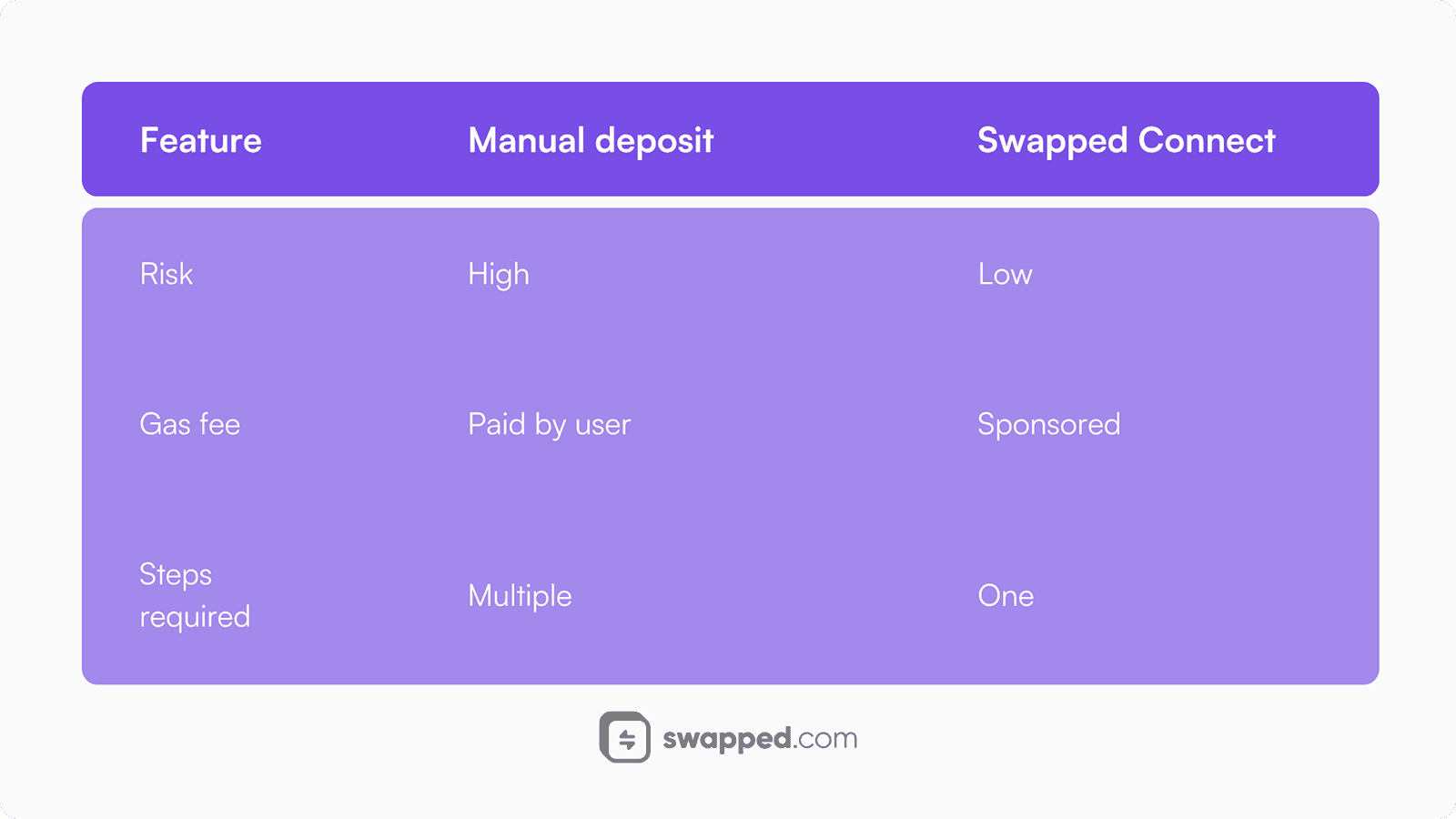
Traditional deposits require multiple steps and leave room for error.
Using Swapped Connect in Your Applications
For developers and businesses, integrating crypto deposits traditionally meant building complex systems to handle multiple networks, tokens, and potential user errors. Our Swapped Connect widget simplifies this to just a few lines of code.
Simple Integration Process
The widget integrates into websites and applications through a simple iframe. Developers just need to include parameters like their API key, wallet address, and user signature. The widget handles everything else – network selection, token compatibility, fee estimation, and transaction execution.
This means businesses can offer seamless crypto deposits without building and maintaining complex blockchain infrastructure. Users get a smooth experience, and developers can focus on their core product instead of crypto deposit mechanics.
Real-Time Management and Support
Our dashboard gives you complete visibility into all deposits. You can track transaction status, view analytics, customize the widget appearance, and access 24/7 human support when needed.
This level of oversight and support isn't available with traditional deposit methods, where users often wait hours or days for help with stuck transactions or deposit issues.
Best Practices for Safe Crypto Deposits
Even with tools like Swapped Connect that simplify the process, following basic security practices protects your crypto and ensures successful deposits.
Double-Check Everything
Always verify deposit addresses and amounts before confirming transactions. While Swapped Connect pre-fills information to reduce errors, developing the habit of verification protects you when using other platforms or wallets.
Start with small test deposits when using a new platform for the first time. Sending $10 worth of crypto first confirms everything works correctly before depositing larger amounts.
Keep Transaction Records
Save confirmation numbers, transaction hashes, and timestamps for all your deposits. This information helps track down deposits if they're delayed or if you need customer support assistance.
Screenshots of successful deposits can also be helpful, especially when dealing with platforms that don't provide detailed transaction histories.
Understand Network Congestion
Network fees and confirmation times fluctuate based on congestion. During busy periods, deposits might take longer and cost more. Planning deposits during off-peak hours can save money and reduce waiting times.
Swapped Connect helps by optimizing routing and timing, but understanding these dynamics helps you make better decisions about when to move your crypto.
Crypto Deposits Made Simple
Depositing crypto doesn't have to be complicated, expensive, or stressful. While the traditional process involves multiple steps and potential pitfalls, modern solutions like Swapped Connect streamline everything into a single, user-friendly experience.
The key is understanding what you're trying to accomplish and using tools that handle the technical complexity for you. Whether you're a beginner making your first deposit or an experienced user tired of juggling networks and tokens, the right approach makes all the difference.
By eliminating manual token swaps, network compatibility issues, and high gas fees, we've made crypto deposits work the way they should – quickly, safely, and without the headaches that traditionally come with moving crypto between wallets and platforms.
Resources
If you're interested in diving deeper and expanding your knowledge of depositing crypto, here are some suggestions: